The Great Lakes spend $20 million a year killing sea lamprey. The next weapon might be written into the fish's own genome.
CHICAGO — Invasive vampire fish, also known as sea lamprey, have been terrorizing the Great Lakes for 190 years, much to the dismay of biologists like Margaret Docker. For 70 years, the lampricide 3-trifluoromethyl-4'-nitrophenol (TFM) has kept the parasitic fish at bay, but researchers are turning to genetic modification in search of new, more effective methods.
According to the Great Lakes Fishery Commission (GLFC), TFM is the current primary control method for targeting sea lamprey in nursery tributaries during their larval stages. Touted for being “…effective, selective, and at treatment levels, non-toxic to fish other than lampreys”, TFM cut lamprey populations by about 90% across most of the Great Lakes.
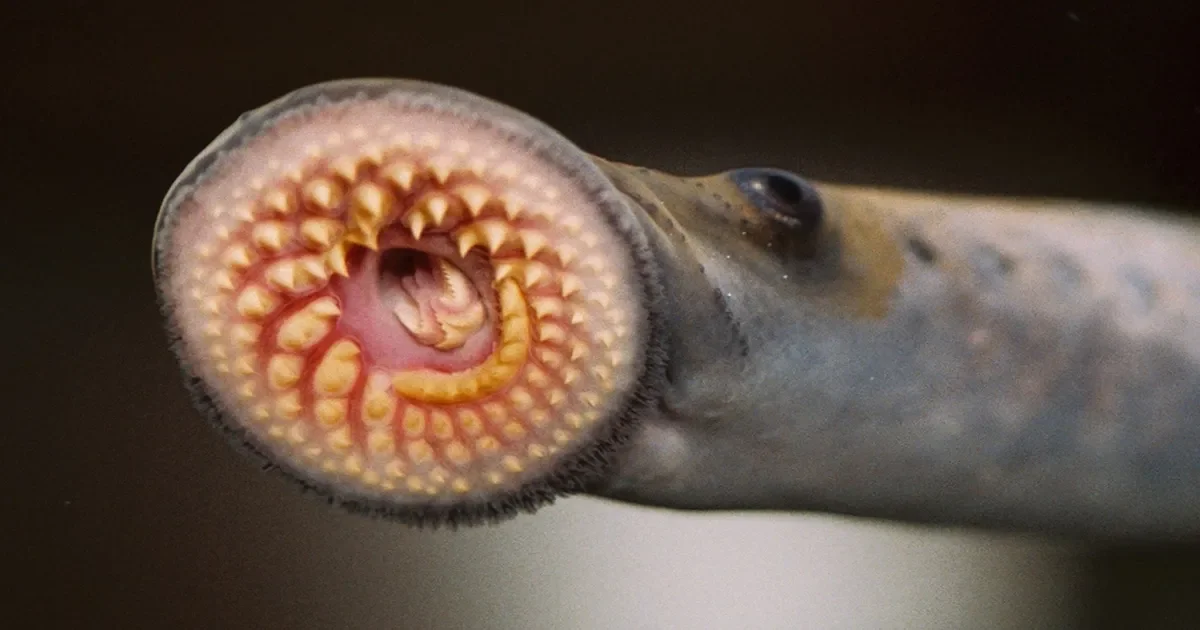
Parasitic sea lamprey (Petromyzon marinus) oral disk
According to Docker, TFM will remain the golden child of lamprey control for the foreseeable future, with no signs of the lamprey growing resistance to the chemical. But where do scientists turn if they do?
“…if sea lamprey were to evolve resistance to the lampricides, then all of the gains made over the past 70 years would be set back,” said Docker. These questions are among many the GLFC are currently asking themselves, and they are leading them down a new path for alternative population control methods.
The most surprising one? Genetic modification.
Futuristic as it may seem, scientists aligned with Docker believe that “…genetic modification offers a theoretically powerful and effective pest control tool”. But modified lamprey in the Great Lakes are far from being implemented in the wild due to lack of testing, uncertain sociopolitical support, and concerns about the lamprey in its native range.
The Great Lakes are no strangers to invasive species, but the sea lamprey has presented a unique challenge to researchers working to restore biodiversity and support struggling fisheries.
The lampreys are parasitic, jawless fish that evolved separately from the native fish species of the Great Lakes, leaving them particularly susceptible. According to the GLFC, one sea lamprey can kill 20 to 40 pounds of fish in their lifetime, and it has no natural predators to keep its population in check. Around $20 million a year is invested in sea lamprey control efforts in order to protect the $7 billion fishing industry. So far, the efforts have been wildly successful.
According to the GLFC, invasive sea lamprey begin their lives as non-parasitic larvae, feeding on plankton for a minimum of three years, depending on environmental conditions. The sea lamprey then undergoes a drastic change, emerging from the stream beds of its larval days through metamorphosis, during which it develops its characteristic oral disks.
These oral disks allow the juvenile lamprey to become parasitic, feeding on and killing host fish that never evolved defenses against them, unlike their Atlantic counterparts. After 12-18 months on the host fish, the lamprey seeks spawning grounds to repeat the cycle over again, unless organizations like the GLFC intervene.
The GLFC has found success using TFM in tandem with barriers, but according to a 2021 scientific article co-published by Docker, both methods are costly, harm native lamprey, and, most notably, may lead to lamprey developing resistance to TFM.
Because of the sea lamprey's resilience and the constant effort required to keep its population at bay, the GLFC is continually looking ahead to new control methods to prepare for the worst-case scenario. Currently, the potential for lamprey to become resistant to lampricides is at the front of the organization's mind.
Docker believes these questions are a smart move for the organization: “If they've been doing this for 70 years, at a cost of roughly $20 million per year, do you just do that indefinitely? Or do you try to do something dramatically different?”
Her version of "dramatically different" hinges on the very DNA of the lamprey.
Docker’s 2021 article states that the gene-editing technique Clustered Regularly Interspaced Short Palindromic Repeats/Cas9, also known as CRISPR-Cas9, is highly effective in sea lamprey and shows viability for editing the lamprey’s naturally occurring genomes, with “the majority of injected embryos being complete or partial mutants”.
In theory, once the modified embryo grows into an adult lamprey, it will pass down its edited genes through a process known as a gene drive.
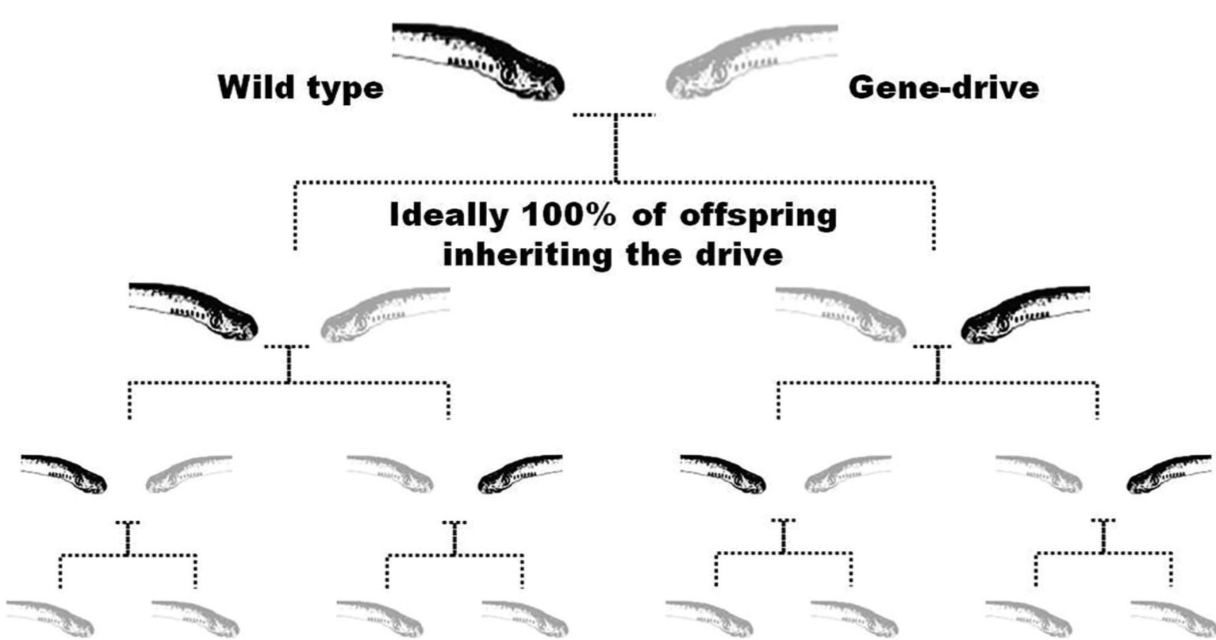
High-efficiency gene drive inheritance. Engineered gene drives are alleles that can bias inheritance in their favor, giving them the capacity to increase in frequency from one generation to the next.
High-efficiency gene drive inheritance. Engineered gene drives are alleles that can bias inheritance in their favor, giving them the capacity to increase in frequency from one generation to the next.
A gene drive increases the chance that an edited allele is inherited by sea lamprey offspring, ideally so that 100% of the modified lamprey's offspring inherit the edited allele. This process works even if the other parent is a wild, unedited lamprey. Using this technique, scientists like Docker aim to engineer an edited gene that will achieve both a 100% inheritance rate via gene drive and a decrease in lamprey populations in the Great Lakes. Two ideas for the population control aspect of the equation include sterilizing the offspring or adjusting sex ratios to decrease the number of breeding pairs available.
Although research like Docker’s has shown viability in other species, the Great Lakes will not see a genetically modified lamprey released into their waters anytime soon. “I would say even best-case scenario, we're still talking decades, I think, until it's sort of realizable,” says Docker.
The current research is only a proof of concept, but looking at other models of genetic control for malaria-carrying mosquitoes has been extraordinarily helpful for researchers. “A lot of the ideas about genetic control for sea lamprey are being informed by genetic control of other pest species,” Docker says.
Despite the researchers' best efforts, genetic research for lampreys presents many challenges. Because lampreys live 7-10 years and are difficult to rear, raising genetically modified lampreys is still just an idea. None of Docker's work has shown genetically modified lampreys surviving past the embryo phase.
The challenges of physical implementation are not the only concerns, however. One of the biggest concerns about genetic control in the Great Lakes is the possibility of impacting sea lamprey in their native Atlantic Ocean range.
The sea lamprey in the Atlantic Ocean has coevolved with its hosts and is appreciated in its natural territory. Researchers like Docker fear that modified lamprey could possibly affect and decimate native populations if left uncontrolled. Although genetically modified lamprey in the Great Lakes is still years away, scientists like Docker plan on sticking out till the very end.